
The program brings together a work by Handel featuring a 14-year-old Russian soloist, the FEMUSC Youth Philharmonic Orchestra, a piece dedicated to historical memory, and a percussion group at the SCAR Small Theater.
The schedule for the Santa Catarina Music Festival (FEMUSC) this Thursday, January 22, features one of the most emblematic moments of the 2026 edition: the Gala Night, highlighted by the Gala Concert at the SCAR Grand Theater in Jaraguá do Sul (SC). The evening unites faculty members and young musicians in performances that embody the festival’s international, educational, and artistic spirit.
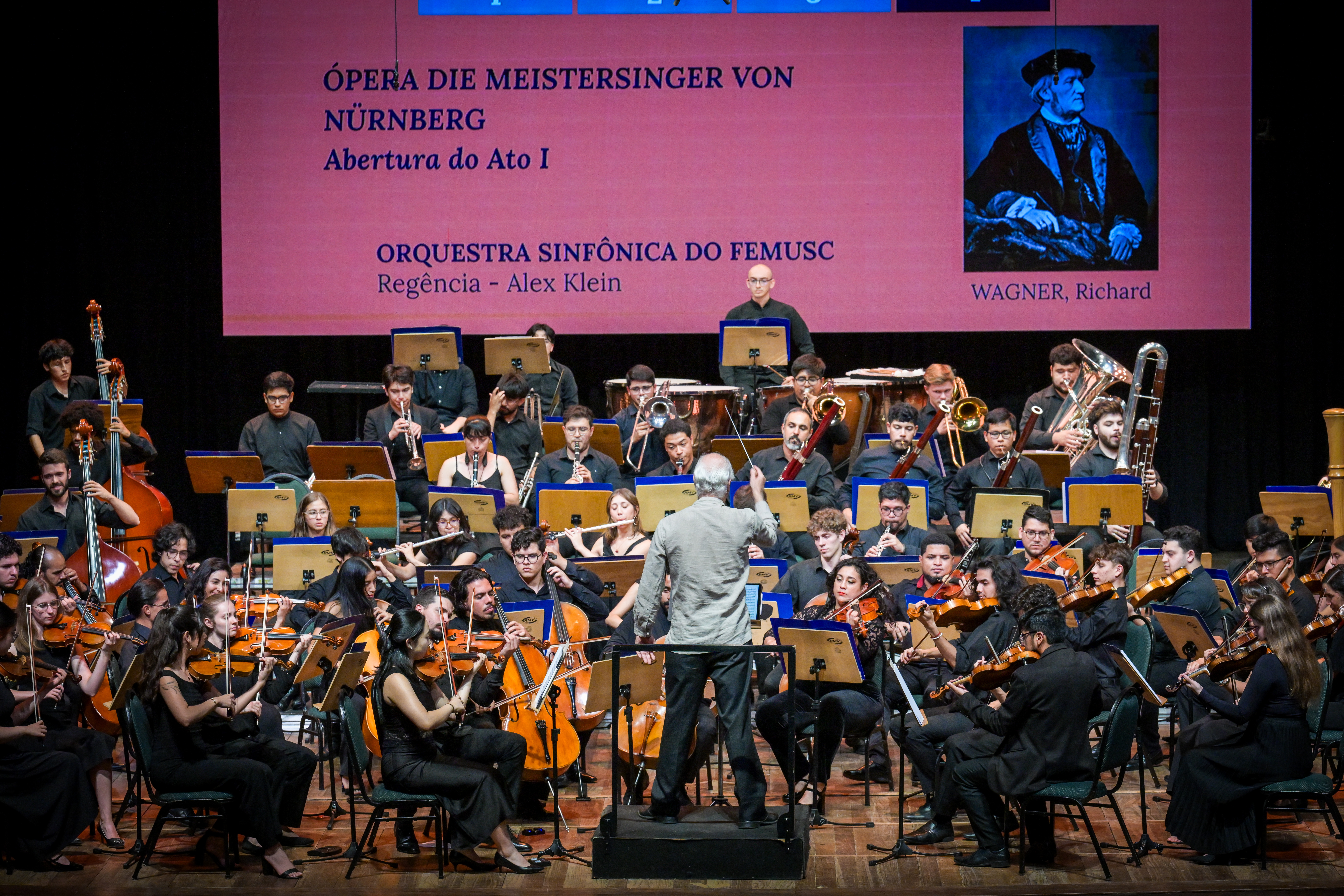
A highlight of the concert is the performance of the first movement of the Concerto for Harp and Orchestra by George Frideric Handel—an 18th-century work—featuring 14-year-old Russian harpist Aglaya Masalskaya as the soloist. She will be accompanied by the FEMUSC Chamber Orchestra under the baton of Alex Klein, the festival’s artistic director.
For Aglaya, the experience of performing as a soloist at a festival alongside musicians from various countries has been deeply impactful. “It is incredibly inspiring and moving. Being surrounded by musicians from so many countries creates a very special atmosphere. As a soloist, I feel honored and motivated to share music in such an international and welcoming environment,” the young musician says.
Regarding Handel’s work, she highlights the concerto’s expressive nature. “To me, this piece is very sensitive and intimate. I perceive the harp and the orchestra as a single ensemble, creating a sound that is light, transparent, and expansive. The harp leads the music in a cantabile and graceful manner, giving me a strong sense of connection and expression,” she adds.
The Gala Night also features the FEMUSC Youth Philharmonic Orchestra—comprising advanced-level students—as well as works that engage with the concert music tradition, such as pieces by Chopin for cello and piano, reinforcing the passing down of the classical repertoire across generations.
Percussion: rhythmic diversity and intergenerational exchange
Thursday’s schedule also highlights the expressive power of percussion. At 7:00 PM, the FEMUSC Percussion Group, led by professor Eduardo Gianesella, will perform at the SCAR Small Theater. During the festival, intermediate and advanced students share the stage with faculty members in a format that enhances the educational experience. “There is a sharing of experiences when we all play together, regardless of skill level. It enriches everyone, without exception,” Gianesella notes.
The evening’s repertoire spans key milestones in percussion music, featuring works such as the Intermezzo from Shostakovich’s opera The Nose (1928); Rítmicas Nos. 5 and 6 by Franco-Cuban composer Amadeo Roldán (1930)—considered the first standalone works for percussion ensemble—and a piece by John Cage from 1940. The program also includes contemporary Brazilian works and a tribute to Hermeto Pascoal, who recently passed away at the age of 89.
“The audience can expect a highly eclectic repertoire that reveals the rhythmic and timbral richness of percussion, featuring works from diverse musical styles and traditions,” the professor summarizes.
For Gianesella, the FEMUSC experience stands out due to its international scope and inclusive atmosphere. “It is Brazil’s most international festival, fostering significant cultural exchange between students and faculty. Furthermore, FEMUSC offers opportunities to beginners as well—something rare at other festivals. Everyone gets to play and gain experience in symphonic, chamber, and solo settings within a short span of time,” he states.
Music, Memory, and Historical Consciousness
Another highlight of the evening is the performance of the work Serioso—written for string octet—which marks the piece’s 20th anniversary and is dedicated to the memory of the victims of fascism and war. The performance is part of the festival’s chamber music program and invites reflective listening, reaffirming music’s role as both an artistic language and an instrument of historical memory.
About FEMUSC
FEMUSC is Latin America’s largest classical music festival and educational program. Marking its 21st anniversary in 2026, the Santa Catarina International Music Festival brings together around 600 students from nearly every Brazilian state and 21 countries—from January 11 to 24—for 14 days of learning, cultural exchange, and abundant music alongside faculty members from the world’s most renowned orchestras. The community of Jaraguá do Sul and the surrounding region enthusiastically embraces the festival, packing the 230 free concerts held at the SCAR Cultural Center and various venues across the city; the event reaches an audience of over 30,000 people, leaving a lasting legacy in the region and in the lives of every student. For more information, visit 🔗 www.femusc.com.br.
The 21st FEMUSC is presented under the Federal Government’s Rouanet Law for Cultural Project Incentives. It features Master Sponsorship from Itaú, Laranjinha Itaú, and WEG; sponsorship from DR Aromas & Ingredientes, Auroracoop, Grupo Elian, Zanotti Elásticos, and Porto de Itapoá; support from Master Operações Portuárias, Mime, Menegotti, Martinelli Advogados, and Unisociesc; and is organized by SCAR, FEMUSC, the Department of Culture, Sports and Leisure, and the Jaraguá do Sul City Hall.
Image credit: Diego Redel