

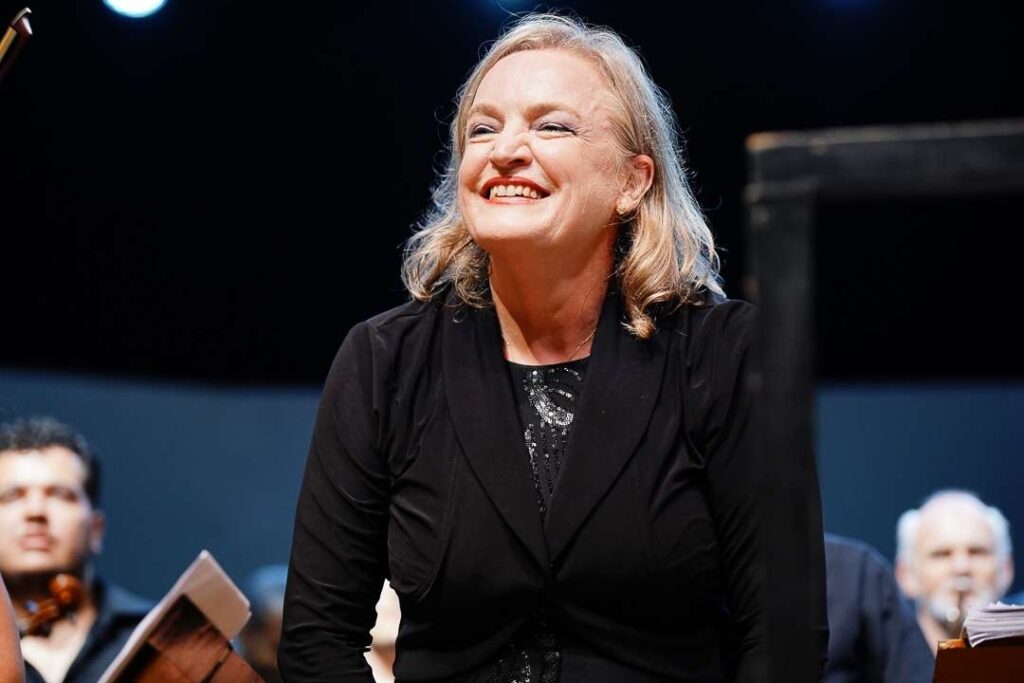
Ligia Amadio is one of the most prominent Latin American conductors today. He became internationally notable for his recognized artistic demand, his charisma and his vibrant performances. His performance, as guest conductor, extends to Portugal, Germany, Argentina, Austria, Bolivia, Chile, Colombia, Croatia, Cuba, Slovenia, Spain, United States, France, Iceland, Israel, Italy, Japan, Holland, Hungary, Lebanon, Mexico, Peru, Czech Republic, Russia, Serbia, Thailand and Venezuela.
Awarded at the famous Tokyo International Competition (1997) and in the II Latin American Competition for Orchestra Regents in Santiago de Chile (1998), he received the “Best Regent of the Year” award in Brazil in 2001, granted by the São Paulo Association of Art Critics. In 2012, he received the Carlos Gomes Award, in the “Regent” category. She was awarded for her performance in all the orchestras in which she was a starter. Among the various awards and decorations he received, the Order of Rio Branco (2018) should be highlighted, the highest decoration of Brazilian diplomacy, as an officer, for services rendered to Brazil in all the countries he worked for. In 2022, she was awarded the Alumni University of São Paulo Award, in her first edition, in the category “Contributions in Art and Culture”.
Ligia Amadio served as head conductor and artistic director at the following institutions: Montevideo Philharmonic Orchestra, Uruguay; Bogotá Philharmonic Orchestra, Colombia; Mendoza Philharmonic Orchestra and Symphony Orchestra of the National University of Cuyo, Argentina; National Symphony Orchestra, Campinas Symphony Orchestra and Symphony Orchestra of the University of São Paulo, Brazil. Since the beginning of 2023, Ligia Amadio has been in charge of the Minas Gerais Symphony Orchestra. Ligia Amadio assumed such positions, elected by the members of the respective orchestras.
Among the numerous orchestras he directed, we should mention: Arpeggione Städtisches Kammerorchester, Baden-Badener Philharmonie, Ensemble Contrechamps, Daughtermonia Czestochowa, Iceland Symphony Orchestra, Israel Chamber Orchestra, Jerusalem Symphony Orchestra, Lebanese Philharmonic Orchestra, Netherlands Radio Symphony Orchestra, Orkiestran Symfoniczną daughterrmonii szczecińskiej, Orquesta philharmonica de Malaga, Orquesta del Teatro Argentino de la Plata, Orquesta Estable del Teatro Colón, Orquesta Buenos Aires Philharmonic, Salta Symphonic Orchesta, Orquesta del Estado de México, Orquesta Filarmónica de la Unam (Mexico), Orquesta symphónica del Sodre, orchesta symphónica Bolivia National, Chilean National Symphony Orchest, National Peruvian Symphony Orchestra, Moldova National Philharmonic Orchestra, Symphony Orchestra Savaria, Silesian Opera Orchestra, Simfoniki RTV Slovenija, Thailand Philarmonic Orchestra, The Congress Symphony Orchestra, Tokyo City Philharmonic Orchestra. In Brazil, he was in charge of the most important orchestras, such as: São Paulo State Symphony Orchestra, São Paulo Municipal Theater Symphony Orchestra, Brazilian Symphony Orchestra, Amazonas Philharmonic Orchestra, Minas Gerais Symphony Orchestra General, Minas Gerais Philharmonic Orchestra, Paraná State Symphony Orchestra, Porto Alegre Symphony Orchestra, Espírito Santo Symphony Orchestra, São Pedro Theater Symphony Orchestra, National Theater Symphony Orchestra Claudio Santoro, Petrobras Symphony Orchestra Pró-Music and Paraíba Symphony Orchestra.
Among the innumerable artists he accompanied, we mentioned a few: Arthur Pizarro, Martha Argerich, Nelson Freire, Bruno Leonardo Gelber, Boris Berezovski, Boris Pergamenschikow, Dang Thai Son, Midori, Antonio Meneses, John Lill, Darrett Adkins, Dora Schwartzberg, Gautier Capuçon, Ieva Jokubaviciute, Jan Krzystof Broja, Joseph Banowetz, Kronos Quartet, Krzysztof Pelech, Linda Bustani, Luiz Carlos de Moura Castro, Patrycja Piekutowska, Pepe Romero, Peter Donohoe, Ray Chen, Renaud Capuçon, Richard Markson, Shlomo Mintz, Yang Liu, Yeol Eum Son, Yi-Jia Susanne Hou, Alexander Kniazev, Anatoli Krastev, Arnaldo Cohen, Andrea Lucchesini, Davide Amadio, Dieter Flury, Homero Francesch, Javier Camarena Ligia Amadio leads and drives the Women Regents movement, having held four editions of the “Women Conductors International Symposium” since 2016. At the third symposium, 2020, 976 participants from 36 countries participated, an event of global importance. As the creator and director of this project, she was one of the finalists for the “2019 Classical: Next Innovation Award”, in Rotterdam. For the direction of this project, she was awarded in 2022, in Buenos Aires, with the National Classic Award, in the category “Gender Perspective Policy”. In March 2023, he held a conference on “Gender Brecha through Art and Culture” at the headquarters of the International Development Bank in Washington DC, in the United States. In October of this year, he will direct the 5th. Edition of the International Symposium Women Regents, which will take place in Las Palmas, Canarias, Spain.
Ligia Amadio began her musical training at the age of five with Prof. Maria Cristina da Ponta Fiore and, after completing the Production Engineering course at the Polytechnic School at USP, she held a Bachelor’s Degree in Regency and a Master’s Degree in Arts at Unicamp, and a PhD in Music at UNESP. In Brazil, his main mentors were Henrique Gregori, Eleazar de Carvalho, Hans-Joachim Koellreutter and Almeida Prado. In 2023, he taught the International Conducting Course organized by the Argentine National Symphony Orchestra and the National University of the Arts, in Buenos Aires. In 2025, he took this course again in November, and joined as a professor in the Master’s orchestral Regency at that university. At the beginning of this year, he was part of the body of professors of the XX FEMUSC, in Brazil, in the discipline of Orchestral Regency.
His training also included the most important international orchestral regency courses: Accademia Chigiana (Italy), International Bartók Seminar (Hungary), Wiener Meisterkürse Für Musik (Austria), International Opera Workshop (Czech Republic), Peter the Great International Workshop (Russia), Inter-American Course for Jovene Directors of Orchesta (Venezuela), Latin American Orchestral Regency Course (São Paulo) and Kirill Kondrashinal MasterClass (Netherlands). In these courses, he had as professors Ferdinand Leitner, Dominique Rouits, Julius Kalmar, Georg Tintner, Alexander Politshuk, Guillermo Scarabino, Kurt Masur and Sir Edward Downes.
His discography brings together 11 CDs and 5 DVDs: ahead of the National Symphony Orchestra, the Slovenian Radio and Television Symphony and the Mendoza Symphony, Argentina. Among them, the realization of the Brazilian Music Collection in Time stands out. From 2000 to 2003 he produced and presented the series Música e Literatura, on Rádio MEC FM, in Rio de Janeiro.